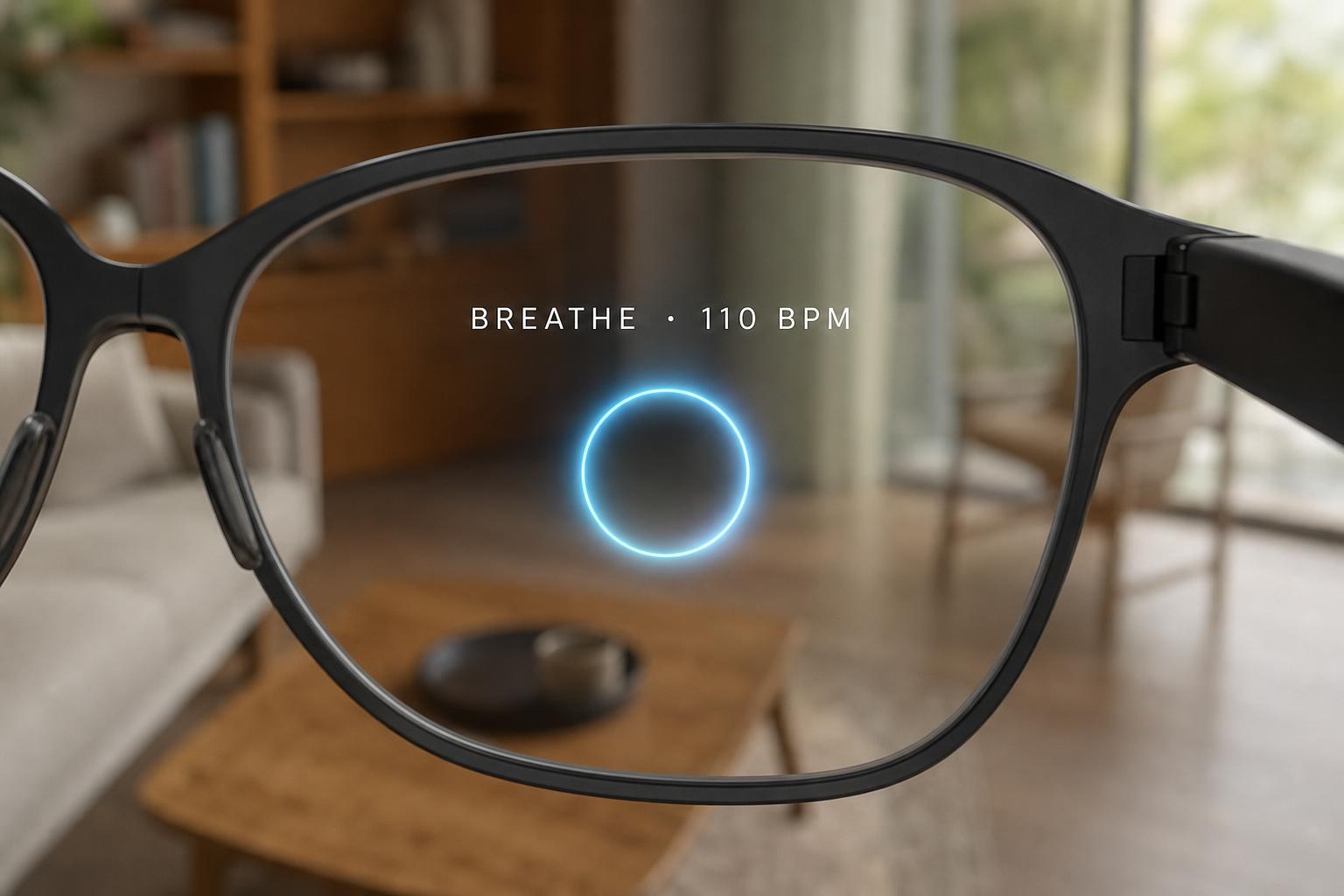
Render · production design in development
Introducing Sixth Lab
Not all overwhelm is the same.
Smart glasses that tell one kind of overwhelm from another — and reflect what's building before it tips into meltdown, shutdown, or burnout. Built for late-diagnosed ADHD and autistic adults.
For investors, programmes, clinicians, and collaborators.
The starting point
Meltdown, shutdown, and burnout are not the same thing.
They feel different. They build differently. They need different responses. Nothing you wear today can tell them apart — so nothing you wear today can help you meet them earlier.
The problem
The system is overwhelmed. The people in it are, too.
Late-diagnosed adults are waiting years for support that, when it arrives, rarely reaches into the parts of daily life where things actually break.
196,000+
adults on the NHS autism assessment waiting list in England (Sept 2024).
Up to 5 years
typical wait for an adult ADHD assessment in some NHS regions.
80%+
of autistic adults have experienced burnout, in community-led research.
Sources: NHS England autism waiting list statistics; NHS regional ADHD service reports; peer-reviewed and community research on autistic burnout.
What we learned
We spoke with 50 late-diagnosed adults. The same pattern kept surfacing.
People described three overlapping experiences — meltdown, shutdown, and burnout — building silently until something visible broke. The interoceptive signals were there. They just weren't legible in time.
“I don't know I'm overwhelmed until I've already shut down.”
“By the time I notice, it's too late to do anything about it.”
“I can mask it in the room. My body remembers for days.”
“I want something that reflects what's happening, not tells me what to do.”
Quotes paraphrased and anonymised from 50 exploratory interviews with late-diagnosed ADHD and autistic adults.
The insight
The body knows first. It just hasn't had a way to say so — yet.
Meltdown, shutdown, and burnout leave different physiological fingerprints — in heart-rate patterns, breath, skin, movement, and voice. Read together, over time, in the context of your own baseline, they become distinguishable. That's the space Sixth Lab is built for.
What only we can do
Glasses are a rare place to see the nervous system honestly.
Continuous, multimodal sensing on your face.
Glasses are one of the only places a device can capture heart-rate patterns, breath, skin signals, movement, and voice together — all day, without a screen in your hand.
Signals that are hard to reach from the wrist.
Facial and cranial signals — vocal micro-features, subtle breath patterns, gaze — sit closer to the nervous-system events people describe than most wrist-based signals.
Reflection over prescription.
We surface what your body appears to be doing. You decide what it means. No score is asked to tell you who you are.
How it works
Sense. Distinguish. Reflect.
Your glasses read the signals your body is already giving off.
Heart-rate patterns, breath, skin signals, movement, and voice — sensed on-device, in the context of your own baseline. No streaming of raw audio.
Patterns that look alike get told apart.
Meltdown, shutdown, and burnout have overlapping surfaces and different physiological fingerprints. We're building models that learn the difference on your body, not on a population average.
You get a mirror — not a manager.
A calm, glanceable reflection of what your body appears to be doing, and how it is trending. What you do with it is yours. We do not diagnose, treat, or predict outcomes.
Proof it's real
Early, honest, and grounded in the people we're building for.
We are pre-product. What we have is a clear problem, real people behind it, and enough technical signal to know the direction is worth walking.
50 exploratory interviews
with late-diagnosed ADHD and autistic adults, mapping how meltdown, shutdown, and burnout show up in daily life.
Working sensing prototypes
on off-the-shelf hardware — the earliest evidence that the signals we care about are recoverable in real conditions.
A research-first roadmap
toward a purpose-built device, developed alongside neurodivergent participants, clinicians, and independent researchers.
The device
Something you'd wear anyway. Doing quiet, careful work.
Sixth Lab is designed to look and feel like everyday glasses. It doesn't ask for attention, and it doesn't try to be a phone on your face.
Under the surface, it's a research platform for reading the nervous system in the context of ADHD and autistic experience — built to earn trust before it earns a place in daily life.
- Form
- Everyday eyewear
- Signals
- Heart-rate patterns · breath · skin · movement · voice
- Processing
- On-device, no raw audio leaves the frames
- Data
- Yours — exportable and deletable
- Status
- Research device in development
The science we're standing on
Interoception, autonomic patterns, and lived experience.
Our work draws on research into interoception — how the brain reads the body — and on autonomic signatures associated with stress, recovery, and dysregulation. We treat that literature as a starting point, not a finish line.
Sixth Lab is not a medical device. We do not diagnose meltdown, shutdown, or burnout, and we do not claim to prevent them. What we do is help make the physiological texture of daily life legible — with the people it affects most in the room.
Privacy
Your body. Your data. Your call.
Sensing and inference are designed to run on-device. Raw audio is not designed to leave the frames.
Your physiological data is yours — encrypted, exportable, and deletable by you at any time.
We don't sell, rent, or share your data with advertisers or data brokers. Not now. Not later.
Where we are
Pre-product, on purpose.
We're not shipping a wearable this quarter. We're doing the unglamorous work first — talking to people, listening carefully, and only then building the thing.
- Today
- Research, interviews, and sensing prototypes.
- Next
- Closed research cohorts with late-diagnosed adults.
- Later
- A purpose-built device, shaped by what we learn.
A note from the founder
Sixth Lab exists because meltdown, shutdown, and burnout arrived in my own life before I had names for any of them.
I want the thing I needed at 25: a quiet mirror that could tell me my body was moving, and roughly in which direction, before it took me somewhere I couldn't come back from that week.
We are building slowly, in the open, with the people this is for.
Aniket · Founder, Sixth Lab
Get in touch
Building slowly, in the open, with the people this is for.
If you're a late-diagnosed adult, a clinician, a researcher, an investor, or a partner who wants to help this exist — tell us who you are and what you're hoping to find here.